


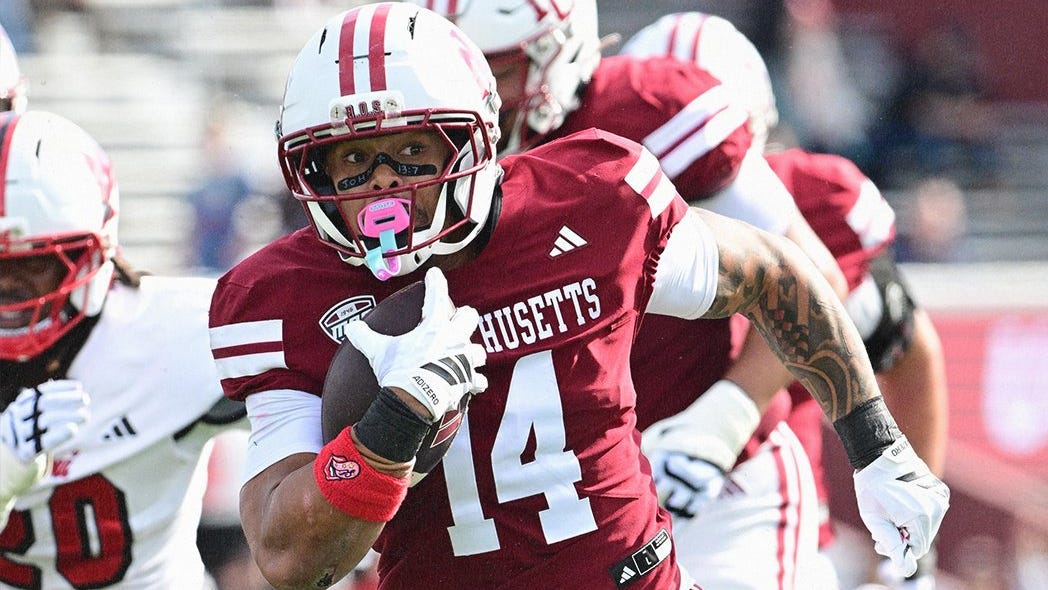
In the aftermath of UMass’ win over Rutgers, all UMass Hall of Fame running back and Command friend Rene Ingoglia wanted to talk about was first-year Minuteman running back Curtis Kimmons IV.
Kimmons and fellow running back Elijah Faulkner may have been the underappreciated stars of the night. In hindsight, their performances should not have been overlooked, and not just because it was encouraging for the backs themselves. They also covered up what should have been a canary in the coal mine for the UMass run game.
Nearly two months later, the Minutemen’s weakness is clear for everybody to see.
UMass ran its way to a 4-0 start, but there were warning signs in September that the run game was overperforming what its offensive line was offering.
Against Rutgers, Kimmons rushed for 78 yards and a touchdown on 11 carries while Faulkner totaled 62 yards on 19 carries while also catching a sweet 21-yard touchdown pass.
Kimmons averaged 2.25 yards before contact, more than double Faulkner’s 0.98 with four runs of 10+ yards. Faulkner gained 44 of his 62 yards after contact, forced four missed tackles and still did not have a run longer than 8 yards.
One back was finding daylight. The other was manufacturing what he could through contact, and the total at the end of the night still said 200 yards.
The Minutemen topped 190 rushing yards in two of their next three games as well with 195 against Stonehill and 232 at Sacramento State. The backs scored, they moved the chains and were a major reason for the success.
Obviously Pop Watson was an important part of the running game as well, rushing for 40 yards against both Rutgers and Sacred Heart before busting out for 72 against Sacramento State. But as the quarterback those numbers also helped cover up the real weakness since his production doesn’t say a whole lot about the line’s ability to control the game.
Even when you take out quarterback runs, UMass ran 110 times for 620 yards in the four wins, 5.6 yards a carry, with 19 runs of 10 yards or more. The running backs alone accounted for 514 of those yards. Kimmons and Faulkner were the engine, producing week after week behind whatever was in front of them.
But the numbers say they weren’t getting much help from those in front of them.
PFF graded the offensive line’s run blocking at 48.6, 61.0, 83.2 and 56.4 in the four wins, below average in three of the four, and the one strong grade, the 83.2 against Stonehill, is also the one game where the backs averaged a season-best 2.48 yards before contact.
According to PFF, 351 of the backs’ 514 rushing yards during the 4-0 start came after contact. That is 68 percent. The backs only gained 1.63 yards per carry before a defender touched them.
The backs forced 20 missed tackles in the four wins, a testament to them, but also a number that was never likely to survive better, bigger MAC fronts tackling the same way.
Those who questioned the quality of UMass’ first four opponents were right to do so.
Take the two FCS games against Sacred Heart and Stonehill out entirely and the picture becomes even more clear. Against Rutgers and Sacramento State, the backs ran 56 times for 265 yards, a healthy 4.7 yards per carry, but 71 percent of the yardage came after contact.
The backs masked the deficiencies up front. Then the schedule turned.
Across the four losses, the backs’ yards before contact fell to 1.03 per carry, their runs of 10+ yards fell from 15 to five.
Eastern Michigan was the last stand of the old formula. Kimmons ran 14 times for 73 yards in a 38-14 loss, and 66 of those 73 yards came after contact, with first contact arriving less than half a yard downfield. He was still solving the problem, but the problem was getting bigger.
And to be fair, the roster was getting thinner.
Jordan Washington, considered by many to be the most talented back in the room, was lost for the season before he ever really got going. Kimmons was limited through the middle of the losing streak and carried just once in the loss at Buffalo.
Meanwhile, Faulkner shouldered the load against Buffalo, carrying the ball 23 times for 84 yards, honest work at 1.31 yards before contact, but it was not enough.
At UConn, the bottom fell out entirely.
Faulkner was met an average of 0.83 yards behind the line on his six carries and still manufactured 14 yards after contact. As a team, UMass produced four yards before contact on its 15 non-quarterback carries and did not have a single run of 10 yards.
Joe Harasymiak summed up the UConn night in two sentences.
“They ran the ball very effectively. We did not,” he said.
Anyway you slice it, UMass’ inability to stay on the field, going 2-for-14 on third down, made it impossible for them to compete.
“2 of 14 is not going to get done, but the distance was probably too much to overcome,” Harasymiak said after.
Gaining yards running the ball on early downs is the easiest and most obvious way to set yourself up for success on third down, but UMass simply hasn’t been able to do that and that’s not because of the backs.
The backs have never been the problem. In fact, they were the reason the problem didn’t become so obvious until October.
The problem has likely been obvious to the staff since the start, but the mini-bye week gives the coaches their best chance to fix it and perhaps their last opportunity to salvage what was such a promising season not that long ago.

Your one-stop-shop for all your sports marketing needs… Owned and Operated by UMASS Grads.
We specialize in providing top-quality marketing & printing services for coaches, athletic directors, and sports marketing professionals.
Get Fan Ready!