


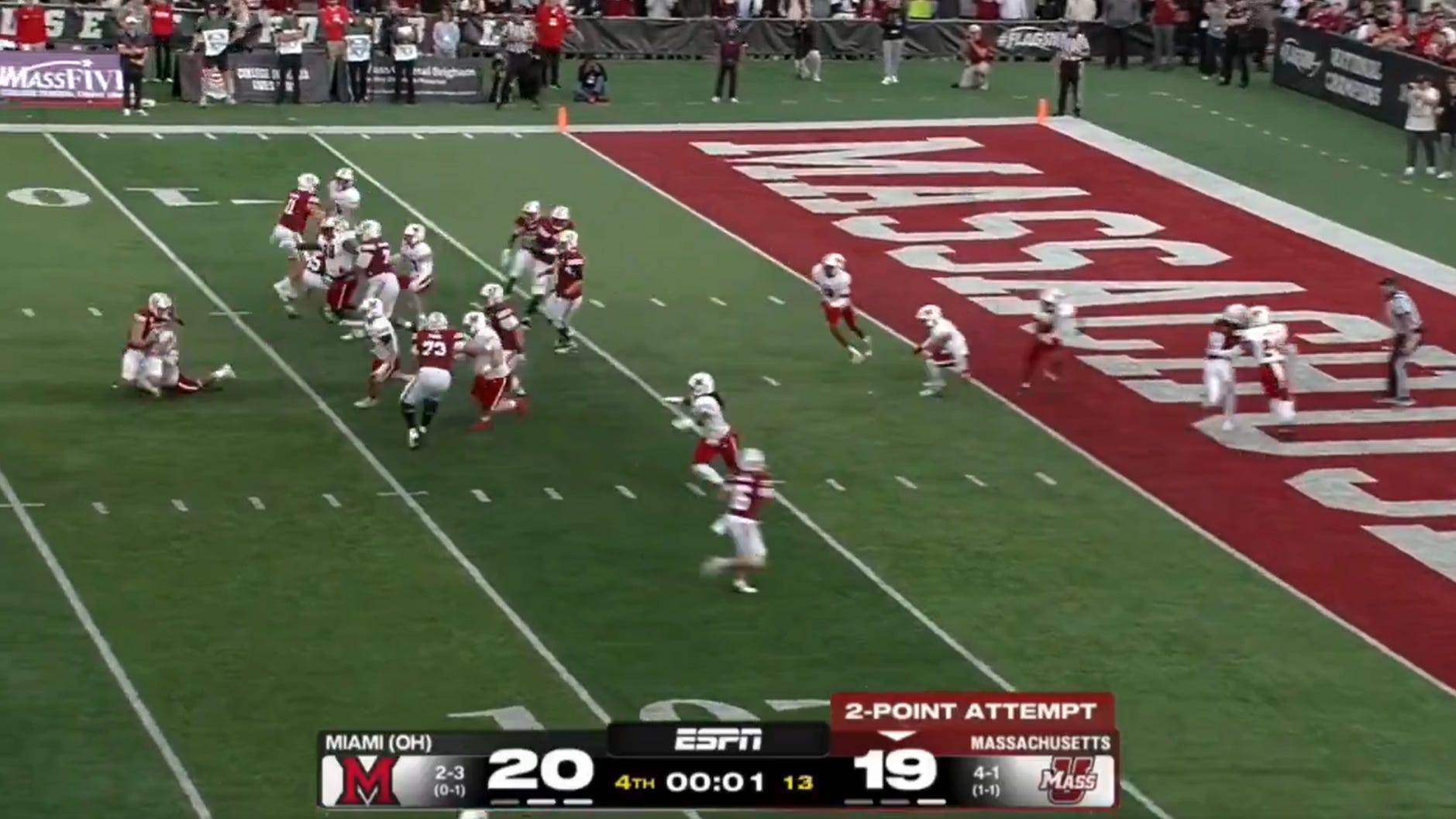
My immediate reaction to UMass’ failed two-point conversion and ensuing loss to Miami-Ohio on Saturday was probably the same as most of the fans: The Minutemen had gone to the most predictable two-point play in football, and Miami was ready for it.
After taking a deeper look, I’m convinced neither the decision to go for two nor the play call itself was the problem.
UMass head coach Joe Harasymiak made the decision to go for the win after Logan Inagawa’s 21-yard touchdown pass to Max Dowling pulled the Minutemen within 20-19 with one second remaining Saturday at McGuirk Alumni Stadium.
Offensive coordinator Max Warner was responsible for selecting the play that would determine the outcome.
Those are two separate decisions and both deserve to be examined and reasonable people can come to different opinions on each, even without the benefit of hindsight.
GOING FOR IT
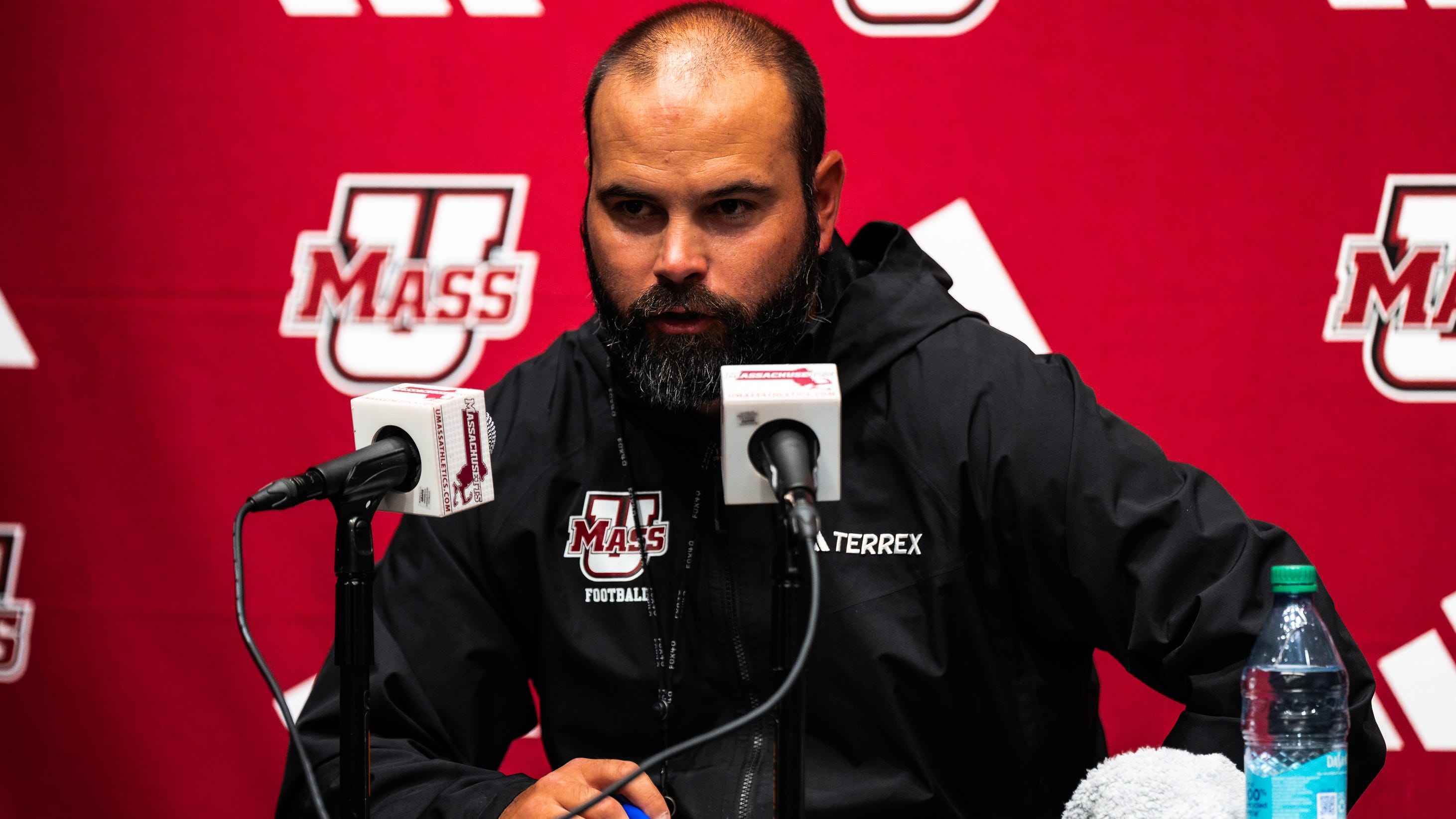
I had no problem with Harasymiak’s decision to go for the win.
The analytics generally support going for two in that situation, and the reasoning isn’t especially complicated.
You figure winning in overtime is approximately a 50/50 proposition. Most coaches believe they have at least one two-point play in their arsenal that gives them a better than 50/50 chance of converting, especially when it’s their best play and one they’ve spent the week practicing.
So the choice essentially comes down to whether you like your chances of gaining three yards on one play more than your chances of winning in overtime.
For UMass, there were additional reasons to avoid extending the game.
The Minutemen were down to their third quarterback after injuries to Pop Watson and Aedan McCarthy. They had entered the game dealing with injuries at several key positions, and receivers T.Y. Harding and Jabari Lewis were dealing with injuries or cramps during the final drive.
Inagawa had just directed a remarkable 91-yard touchdown drive, but there was no guarantee UMass could sustain that offensive production through overtime devoid of much of the firepower they’ve had all season.
And there’s another factor that goes beyond the numbers.
Whatever philosophy a coach preaches should show up when the stakes are highest.
Harasymiak consistently encourages his players to be aggressive, and to his credit, he generally coaches that way when opportunities present themselves. It’s easier to ask players to compete aggressively when that mentality extends throughout the program, beginning with the head coach.
“Listen, I’m here to be aggressive,” Harasymiak reiterated immediately after the game. “I’m here to win games. I’m not going to play scared…I trust our guys.”
Harasymiak also revealed that the coaching staff had spent the week anticipating a low-scoring game.
“It’s funny because all week as a staff, this is true, we said it’s a race to 21,” he said. “And that would have been 21.”
He was willing to put the outcome in his players’ hands. I have no issue with that.
THE CALL
This is where my opinion changed after reviewing the play.
From the press box, I recognized the Philly Special a fraction of a second after the ball was snapped. So, probably, did you.
It’s probably the most recognizable two-point play in football. When it failed, my immediate reaction was that Warner had gone to a play everybody could see coming.
But there’s a reason why the play is so popular in these situations.
Recognizing the Philly Special from the stands, on TV or in a coaches’ booth is entirely different from recognizing it as a defender on the field at the snap.
The offense doesn’t need to fool everyone watching. It needs the defense to react a certain way at the snap. Miami reacted exactly the way the Minutemen needed them to.
Even with a third-string quarterback and freshman walk-on receiver Drew Alsup involved, UMass was in control of the pre-snap operation. What initially appeared to me to be some communication issues weren’t issues at all. It was simply more of Warner’s pre-snap eye candy.
Alsup handled the initial exchange from Inagawa and flipped the ball to running back Reece Adkins with no problem. Lewis did an excellent job taking the playside cornerback out of the play by running a slant and maintaining contact making it more difficult for the corner to just bail.
Meanwhile, Inagawa showed an enormous amount of patience.
He must have been dying to get out to the flats, but he waited - waited for what must have seemed like far longer than the second or so it was - until Miami defensive lineman Zhaiylen Scott committed to chasing Alsup.
The instant Scott took himself out of the play, Inagawa made his move. And he was wide open.
At the 6-yard line, Inagawa had nobody between himself and the end zone.
The only Miami defender who recognized what was happening was the one defender who never had a chance to do anything about it, backside cornerback Amariyun Knighten.
Knighten can be seen sprinting across the formation toward Inagawa, but he wasn’t going to get there in time.
UMass had the look it wanted. The defense had reacted exactly as the Minutemen needed it to react. The intended receiver was uncovered.
The play was there.
Except one thing went wrong.
A blitzing RedHawk linebacker came through without being picked up and tackled Adkins before he had an opportunity to throw the ball.
That single breakdown erased everything else UMass had done correctly.
“We practice that play a lot,” he said. “I believe what I was told is there was a backside run-through in the A gap or B gap that got penetration.
“It’s hard, man. I love these guys and I’m here to win and I trust them. We’ve just got to keep going.”
It’s an almost perfect illustration of the 9.09 concept Harasymiak and his staff have emphasized throughout the season.
All 11 players have responsibilities. When one player doesn’t execute his assignment, the other 10 can do everything right and still come away with nothing. That’s what happened here.
Of course, the ability to execute a play has to be part of the decision to call it.
Maybe Harasymiak and Warner overestimated their players’ ability to execute that particular play in that particular moment. That’s a fair question, but that wasn’t my take in the moment.
UMass had a chance to win the game. Harasymiak chose to take it. Warner called a play that got the intended receiver open. The Minutemen simply couldn’t finish it.
Harasymiak will undoubtedly revisit the decision, as will Warner and the players involved. But at some point, coaches have to trust their preparation and their players.
“I’ve got to live with it, but I would do it again and I trust our guys to go do it,” he said.

Your one-stop-shop for all your sports marketing needs… Owned and Operated by UMASS Grads.
We specialize in providing top-quality marketing & printing services for coaches, athletic directors, and sports marketing professionals.
Get Fan Ready!